According to Kennedy, silhouette thumbnails are one of the most commonly used exercises in pre-production in the creative industry. People recognise objects and other humans by their silhouette long before they see details. Using silhouettes in addition to references can stimulate creativity and imagination, and produce a high number of concepts in a short amount of time. My own process follows more traditional media, sketching and scanning, which often takes longer as I tend to become precious about designs. I think adapting to this digital pipeline will not only help me overcome that and become more productive, it will raise my skills to that suited and expected of the industry.
Initial designs are discussed with the art team or director, and another batch is normally drawn, developing on the most popular previous designs and refining. The next step is to introduce detail, and using a greyscale value painting is a great way to convey the major abstract shapes of the details of the character. Sometimes, many iterations of a character is needed, as the first variation is almost never picked. With direction from the art team, a selection of the iterations may be chosen and have more detail and colour added to them.
Like the previous post of this name, this covers a number of patterns concerning design theories and elements I've noticed throughout my research. The Balance of Narrative & Mechanics Duos often fail because they do not really aid game progression. Their presence should provide a level of physical or narrative contribution. A highly practical way to justify using duos is to base mechanics off the requirement of teamwork to get through the level. In Enslaved: Odyssey to the West, Monkey is the fighting force who's athletic manoeuvrability finds and clears the way for Trip, but sometimes he has to rely on her tech skills to see hidden land mines, open locked doors, or provide a holographic distraction so he can reach his goal unhindered. I believe this game has a near perfect balance of narrative and mechanics, which justifies the use of both characters.
Prince of Persia is heavily designed around the gameplay element, and uses teamwork effectively. Some reviews though felt that Elika was a bit tagged on for these elements, as she was a more of a cheat for not dying. Beyond the cutscenes that convey the major plot points, narrative was also lacking. To really get to know each character and the world, the player had to activate conversations with Elika, and depending on where the player was, this sometimes resulted in her not having anything to say, so the Prince made comments to himself. This left me feeling a bit unsatisfied as so much more could have been done. I believe narrative must at least reach a certain acceptance level if such development is attempted, and while gameplay will always be a stronger element here, there needs to be a better ratio.
Balancing Originality & Familiarity
Before
designing a character, there are pivotal elements to consider first.
In a world full of entertainment media, an immense range of
characters already exists. So how is it possible to create an
original character that stands out? Without going into gameplay or
story, it is vital that the visual elements are grounded by
originality balancing with a touch of familiarity. Antony
Christoulakis, lead artist of Neon
Studios, claims a character “should
have something human in its nature - something that people know and
understand from our real world. If you just design the most weird
alien creature you can think of, people will find it hard to create
an emotional connection. But he also has to have something new to
stand out from the crowd.” (Hartas 2005, p.20). There should always
be some aspect people recognise to relate to.
As
an interactive medium, how a character will be used in a game impacts
their design. Likely, if a character is bulky and slow, they will not
be springing over platforms like a squirrel. The character has to
aesthetically fit the role they were designed for. If a character's
design does not match the intention for gameplay, this will disrupt
the player's immersion.
Reoccurring Archetypes Throughout my research of duos I've come to find there are reoccurring archetypes for the pairing and their relationship. Although some may start of differently, as the characters develop they can come to be known for what they finish as, such as strangers to friends, or friends to romance. There's a mix of a friendship and leader-sidekick type in Ratchet & Clank. There are family-based relationships like siblings in Brothers: A Tale of Two Sons, and although unrelated, a father-daughter bond forms in The Last of Us. While starting as strangers, friendship and even hints of romance develops in Prince of Persia and Ico, while in Enslaved: Odyssey to the West, they first form more like enemies before developing. From my case studies and previous research I've identified these popular archetypes, and will use them for my own designs.
David Freeman has explored emotions in games extensively, and has 32 categories his Emotioneering techniques can fall into. These techniques can then be applied to strengthen the bond between each character and towards the player. The Character Diamond is used to design the personalities of dynamic and interesting characters. The Diamond's four corners each represent a Trait, which dictates how the character sees, thinks, and acts. Major NPCs should have at least three corners, but can have up to five, with the risk of too little making the character boring or cliché, and too many making it hard to read the character. This technique can be applied overall to a group, while the characters still retain their individual Diamonds. Using this helps identify a collection of characters working as a single entity, and could aid in portraying a duo's compatibility and relationship. The use of this technique can aid me in keeping a character distinct, individually and when with others. It will firmly keep in mind how the character thinks and acts, which is not to be confused with quirks like being clumsy, or situationally appropriate emotional outbursts.
The Character Arc is the development process characters should go through, as people never stay exactly the same when they have an emotional experience. When a character faces an emotional struggle and they overcome it and grow, it makes for a gripping story. To be able to develop, the character's personality and context must be understood early on. They should be designed with their history in mind, as you cannot give a character a strong personality if they have no roots. This evolution can cause a change in their Diamond.
Colour is used as a means to convey certain qualities, and applying this to character design can aid interpretation of behaviour traits. Complimentary colour schemes suggest harmony, while contrasting schemes cause dissonance. Warm colours attract and stimulate the eye, while cool colours tend to recede and have a calming effect. In The Legend of Spyro: A New Beginning, Spyro is a rare purple dragon who is prophesied to lead the fate of his time. Purple is seen as noble, symbolising ambition, extravagance, and magic, which suits the character.
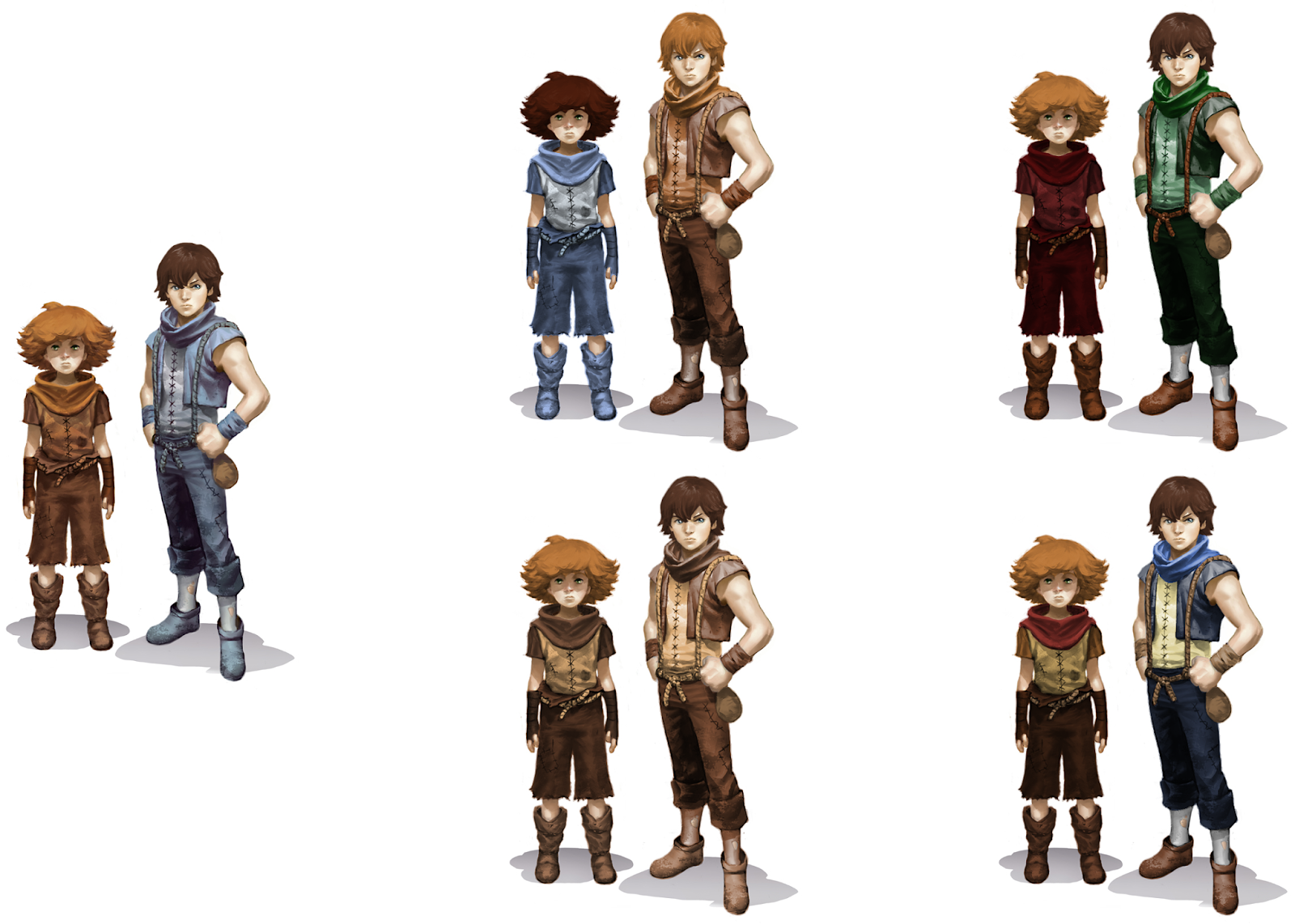
Colour is used in Brothers: A Tale of Two Sons to contrast the characters from the environment and each other. I experimented with changing the complementary colours, and also desaturating them for a more natural feel. The last design is my preference in that the designs aren't over saturated like the original, but still have highlights of identifying colour. The younger brother's personality is shown through the warmer, more active oranges and browns, while the older brother, who is calmer and more responsible, is mostly blues.
In Prince of Persia, there was a drastic change from the earlier designs of both characters, especially in the colours. The original iteration of Elika had much of her ratio being taken up by the bold red, which was a bit aggressive for her personality and the rest of the environment. The Prince's blue scarf suggested he was the calmer of the two in comparison, and the change to the current colours suits both much better. The glowing white of Elika's shirt give her a more mystical atmosphere, and the Prince is clearer on screen with the red and blue scarf instead, and the wider spectrum of other colours doesn't make him as bland as he did in the earlier design.
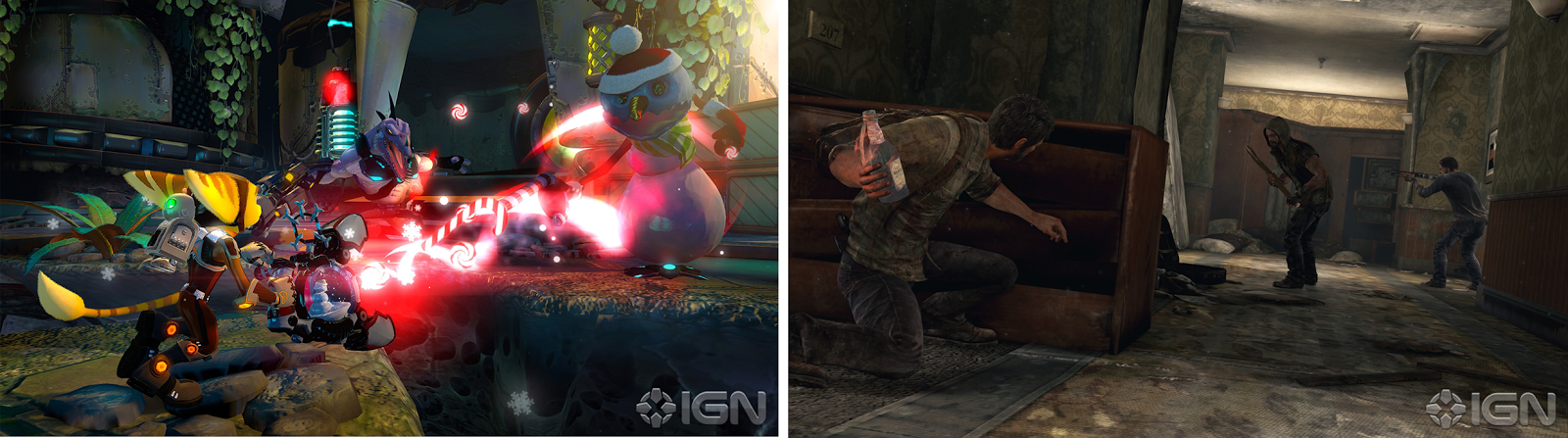
Throughout my research so far, there are a number of patterns concerning design theories and elements I've begun to notice. The following are brief examinations of these. The Relationship of Art Style, Genre & Target Market Art style can aid a games mood and atmosphere, and support story and connectivity to the player. It can relay emotional expectations, such as the colourful, clean, cartoon-based visuals of Ratchet & Clank, in which the characters go on adventures, have fun, and overcome difficult situations, but stays relatively light. On the opposite scale, The Last of Us features a realistic gritty style that reflects the serious subject matter and emotional development of the characters. There is an emerging correlation in art style and genre, which can affect the target market. Ratchet & Clank can appeal to all, although leaning towards younger generations, but the maturity of The Last of Us reserves the game for adults. Additionally, cartoon-based styles feature more exaggerated proportions and are often creature-based, while realistic styles tend to use more human and humanoid designs. As such, visual style should fit the role of the story, and be sensitive to the subject matter and genre.
Character Hierarchy & POV
Within the popular archetypes there is a pattern of hierarchy. Primarily, the second you step into the game, the character the player is controlling is generally higher up in the hierarchy. This is often the leader character, rather than the sidekick, or the older, bigger character that directs the story and has more influence on events. Another pattern is that bigger characters are often the brawn, and smaller companions are the brains. In a male-female duo, it's often the male being controlled and in the lead.
There are occasions when this pattern is broken, and going against conventions makes for more interesting characters and story. For instance, in Brothers: A Tale of Two Sons, you control both characters at once with each joystick, which makes them more equal in stature, and really brings out their teamwork element. In The Last of Us, you eventually switch to play Ellie, the younger, less experienced character, and in Ratchet & Clank you can play at certain points as Clank too. I believe design and roles affect character hierarchy, and it could make more interesting characters if these conventions are broken, such as playing the game from the point of view of the character lower on the hierarchy.
Based on the shape and
silhouette theory I discussed in a previous post, I decided to test
its validity by examining the elements in practice. I've selected
the most popular choices for my case studies as part of this
examination. I used images that showed the duos as clearly as
possible, traced their silhouette, and added the red lines over it to
form the most obvious square, circle, and triangle shapes. The theory
is that these shapes have pre-existing aesthetic assumptions that
have formed over art history and human perception. Circles are soft,
friendly, safe and represent innocence, youth, femininity; Squares
show strength, maturity, stability, balance, and stubbornness;
Triangles are athletic, dynamic, precarious, and convey aggression,
masculinity, force, and energy.
It has been mentioned by both Chris Solarski and Michael D. Mattesi that the theory is not a definitive formula, which I agree with in many ways. For example, the effects vary in the character's design over different art styles. Shapes are much clearer to see in more simplistic visuals based from cartoons etc, and the more realistic an art style the harder it is to define them. You can see this in Ratchet and Clank which are more readable, but once you start looking at more realistic forms and proportions characters start to look the same, lose their uniqueness, and tend to be made of mostly varying sizes of rectangles. Use of stylisation can help make a few of these realistic-based styles pop, as with Monkey who hunches and has rounded shoulders and long limbs, making him relate to the animal he's named after. It also appears that creature-based designs like in Ratchet and Clank, Jak and Daxter, or Spyro who are naturally more unique in form where shapes are easier to read than in humans.
Shapes can also be interpreted in the character's gestures and movements. In The Last of Us, the world is very realistic in most senses, and the characters move in paced lines dictated by real world physics, whereas in Ratchet & Clank, when you jump you move in an arc and movements are more exaggerated. Other examples could be when the character is injured, and this low state in health could show in a more sluggish or restricted appearance. Overall, I believe there to be a ratio between this theory and its effectiveness to the visual style used, as the more realistic an appearance or movement, the less defined shapes and their impact are.
I've known of the idea of the psychology of shapes and silhouette for a few years now, but I can't pinpoint where I learned it, much like having knowledge of the colour wheel and relevant theories, but not knowing specifically where it came from. I've just carried on with the thought that these theories are a commonly accepted practice that many artists agree on, which justifies them. Now, I want to go into the ideas with more depth, and actually provide evidence that shows my research.
Going back through my art books, I've found references to such theories. In The Complete Book of Drawing skills by Barrington Barber, form and shape is discussed as a way to "break down the process of visual perception to its fundamentals". It explains that our eyes take in shape, colour, light and shade, and our mind interprets images based on our experience to form something we recognise; "Shape is the outline visual impression we have of an object. Because we get used to seeing objects in certain positions we tend to see what we expect to see rather than what is actually there". The chapter goes on to continue with how instinctive recognition uses characteristics of an object to define it and its role, and how there are clues to its identity in the shape. In this series of silhouettes below, you can tell by experience and symbol associations that the images are planes, but the details in their main frames allows you to identify the individual models of the aircraft. This works in the same way in other given examples, such as when you see the Eiffel Tower, you think Paris, or the East when you see the Taj Mahal.
I found an article online by Chris Solarski called The Aesthetics of Game Art and Game Design, which covers the psychology of shapes and dynamic composition in depth, extending the theory from not just character shape but also the way they move in animations, the paths laid out in levels, and the relation of their shape to the shape of the environment. It mentions this is based on the topics from his book, Drawing Basics and Video Game Art, which I'll be looking into to cover this topic in much more depth. It begins with saying artists can deconstruct objects into their simplest form to aid in rendering reality, and that primitive shapes have aesthetic associations in art, in relation to our life experiences and sense of touch: Circle: innocence, youth, energy, femininity Square: maturity, stability, balance, stubbornness Triangle: aggression, masculinity, force
He gives the example of the sphere, cube, and star objects pictured above on a table, then imagine shaking that table to show their properties. The sphere would roll, and the cube would stay in place. If the objects were thrown at you, you'd catch the sphere easily, but would hesitate with the star because of the sharp edges. This concept of associations with the three shapes, which Solarski refers to as a shape spectrum of emotions, can be incorporated into any design, as shown in the example below. He also states that this is not a definitive formula, but a tool to assess artwork.
This theory can be applied to various design elements. These were the examples given:
Character Personality: Mario is dynamic, youthful, and positive, and circular based. Luigi is the supportive brotherly type, shown in his vertical rectangle figure, and Wario is aligned to the triangle, which portrays his aggressive enemy role.
Character Animations & Paths: Lines of movement can be used to convey personality, emotion, or physical status, which can clearly show alignment to curves (delicate, dynamic), straight lines (slow, peaceful), or angular lines (aggressive). Journey uses broadly visualised lines in the character's movements in such a way; "In the opening sections of the game, the character has an upright posture and jumps freely and gracefully. But we witness a delicate shift in the character's physical state as we eventually guide it up into the storm where it begins to hunch forward against the pounding winds."
Character Shape vs Environment Shape: A character's relation to their environment can suggest similar responses and create narrative. "A circular character in a circular environment (top-left) exhibits a sense of harmony because the character's shape is echoed in its surroundings. The echo gives us a sense of home -- suggesting that here is where the character belongs. We also get a sense of harmony if both the character and environment are square, or triangular (lower-right), although the change of primary shape gives us a different aesthetic sensation. We get a sense of dissonance when character and environment shapes contrast each other. A circular character appears threatened when placed in an edgy environment (top-right); while a triangular character appears the threat in a soft and rounded environment (lower-left)." Solarski also states breaking the conventions of these shapes can make more interesting characters. For instance, a character might be full of triangles and their design portrays them as a villain, but they might turn out to be the hero who is friendly and kind. This makes the story emotionally richer and engaging.
In Michael D. Mattesi's Character Design from Life Drawing, the artist discusses the importance of understanding depth and flatness in art, or form and shape respectively. By using shape design to build up the smaller elements allows for an interesting launch point before filling it with form and detail. He states, however, that it's best not to get trapped into drawing like this too often as it can result in a flat, dead design (much like Solarski); "The shapes are abstract parameters of the figure for placement relationships". Using shapes is only one step to make unique designs, and should be built upon further. He uses shapes as abstract thoughts to aid in placement of the figure, and proportion is secondary. Again, shapes are said to have emotional relationships to us: Triangle (Point down): athletic, dynamic, precarious Triangle (Point up): solidity, unmoving, energetic Circle: friendly, soft, safe Square: strength, solidity
As you can see in the image, he goes on to apply force to the bottom row of shapes to bring them to life, whereas the top row is static because of their symmetry. This theory follows his rules of straight to curve design in depth to create forceful shapes; the curve represents force, and the straight line is structure. From this selection of artists, it's clear they each conform to certain aspects of shape theory, such as emotional or aesthetic qualities in certain shapes, our instinctive associations with the forms silhouettes make, and the process of using shapes to build upon for interesting designs. I agree with most of what they say, and so will try applying this to my work in my practice-based research to see what kind of impact it has on my style and process.
Leo Hartas' book The Art of Game Characters may be a little dated (2005), but I believe a number of the principles can still apply to today's games. It showcases a number of popular characters and examines their appeal and the techniques involved in their creation. What stands out the most to me, however, is the format of the chapters which have been titled after a combination of character archetypes and art styles. Archetypes represent strong traits that are found in characters, which allows us to categorise them. They have become an interest of mine in how they help to reveal the base identity of characters in games, where their design might give me certain expectations for their personality. This is an area I'd like to explore in depth, because while individual characters can be categorised, how can this be applied to pairings? Can they still have that strong sense of being a unit if their individual archetypes are dramatically different? The following is how Hartas has described each chapter type with a few examples of each. Game Cuties Cute cartoon characters. e.g. Pac-Man, Mario Brothers, Donkey Kong, The Legend of Zelda's Link, Rayman, etc... Big Biceps Tough guys with muscles. e.g. Superman, Spiderman, Fantastic Four, Duke Nukem, Street Fighter, Mortal Kombat, etc... Sexy and Sassy Attractive and alluring characters. Tomb Raider's Lara Croft, Beyond Good and Evil's Jade, Kya: Dark Lineage, World of Warcraft, Dead Or Alive, etc... Mad, Bad, and Dangerous To Know Bryronic heroes. Hitman, Max Payne, Metal Gear Solid's Snake, Gabriel Knight, Darkwatch: Curse of the West's Jericho, etc... Femme Fatale Sirens. Tomb Raider's Lara Croft, Blood Rayne, Prince of Persia: Warrior Within's Shahdee, Final Fantasy x-2's Paine, Darkwatch: Curse of the West's Tala, etc... The Reluctant Hero Victims of circumstance. Beyond Good and Evil's Jade, Devil May Cry's Dante, Prince of Persia: Warrior Within, Final Fantasy XII's Ashe, Ico, Driv3r's Tanner, etc... Fascinating Flaws Anti-heroes and villains. Grand Theft Auto. Driv3r's Tanner, Soul Calibur 2's Nightmare, Killer 7's Harman Smith, etc... Mainly By Cunning Tricksters. Thief's Garret, Splinter Cell, Deus Ex, Commandos, Silent Storm, Galleon, etc... It Could Be You The everyman. The Sims, Space Colony, Animal Crossing, Beyond Good and Evil's Jade, etc... Baby Face Manga. Fightin' Jam's Ingrid, Animal Crossing, Shin Megami Tensei: Nocturne, Skies of Arcadia, Dragonball, etc... Behind the Mask First-person characters. Halo's Master Chief, Half Life's Gordon Freeman, Red Faction 2, Timesplitters, Return to Castle Wolfenstein, Doom 3, etc... Do You Speak Elvish? Fantasy creatures. World of Warcraft, Everquest, Lineage 2: The Chaotic Chronicle, Chaos League, Kohan II: Kings of War, etc... Monster Mash Robots, dinosaurs, and aliens. Fable, Grabbed by the Ghoulies, Metroid Prime 2: Echoes, Ico, Blood Rayne, The Lord of the Creatures, etc... Oddballs Wacky characters. Ratchet & Clank, Psychonauts, Rayman, Voodoo Vince, Armed and Dangerous, etc... Bosses From Hell The big baddy. Final Fantasy X-2, Sudeki, The Legend of Kay, Kameo: Elements of Power, etc... While reading this book, I've recognised the archetypes quite clearly, and have also thought of more modern characters that would fit in the categories. In certain cases, the sections in the book are more art style based, such as the manga and cute chapters, but overall - is there certain art style associations with archetypes too? Would an archetype suit some visuals better than others, and how much does the story and gameplay impact this?
After a quick preview of Bryan Tillman's Creative Character Design, he dedicates a chapter to archetypes and their importance. A major point Tillman tries to get across is that "The character is always in service to the story", so that it is the story that will dictate if you need a hero, not the other way around. The selection he studies are based from today's most prevalent archetypes set by the psychologist Carl Jung, as follows; The Hero: brave, selfless, willing to help others no matter the cost. The Shadow: strong connection to instinctual animal past, ruthless, mysterious, disagreeable, evil. The Fool: goes through the story in a confused state, gets others into undesirable situations, tests the main character's reactions. The Anima/Animus: (Female/Male) embodies human urges, sexual desires, love interest. The Mentor: has profound knowledge, helps protagonist realise full potential, often associated with age and wisdom, like a parent. The Trickster: constantly pushing for change, good or evil, moves story for their own benefit, puppet masters, influences character's decisions. From these two books, the are some commonly agreed archetypes. Once I get a copy of Tillman's book, I'll study his interpretation more, and for now I'll look into Carl Jung's extended list that was mentioned. Once I have a better understanding of archetypes, I'll examine how this has been applied in existing games with pairs. Do the individual characters fit a certain type? Can both be the same type, or is it best if they're similar or contrasting? How does archetype effect the pair's hierarchy? What might be interesting to do is define the terms of my own archetypes, but keeping them recognisable, as cross referencing may not be an exact fit in some cases. As this will be a design project, with the final outcome most likely being a non-interactive visual, how much should I let archetypes affect my characters? They are there as building blocks, to aid in conveying role and hint at personality, so they can't stay too basic or go too far from the base concept least my designs lack that spark of familiarity. Perhaps I should also go back to Joseph Campbell's Hero with a Thousand Faces, as this might help define structure as well.
To have a fuller understanding of paired companions, of how they're created and used, I think it's best to look beyond just games. Of course, games as an interactive platform are different in many ways from films, tv, novels etc, but I believe there should be many similarities in the foundations. At the very least, partial narrative elements and the development of relationships should be transferable, as well as character design itself.
In a game with pairs, both characters are vital and need to be of high quality in design as well as performance. They should both be considered main characters, and be equally developed. By reviewing what has been done before, I can start to form assumptions on their levels of success and why. In many of these media, the characters are a prime focus of the story, as the narrative usually follows the events that occur to or around them, how they deal with it and so on, which is what engages the viewers emotionally. The following are examples of duos in various media:
What is standing out most to me for now is the types of pairings there are, and the relationships they tend to form. Can duo archetypes be conveyed through design like single characters can? This also brings to mind how the hierarchy is portrayed too. In terms of variables that are used to differentiate between characters, there's: size, age, gender, intelligence, status etc. A good way to show this is contrast: big and small, young and old, male and female, brains and brawn, rich and poor etc. These existing types can already have certain connotations, such as the brains being small, and the brawn big. But in these areas, out of which pair is controlled by the user? Often you would play the younger character, and be taught by the mentor throughout the game. But what if you were the one teaching? Would players enjoy a mix up of the archetype? In some cases there might not be enough of a foothold to get a good story or experience. An example I read of once was in Programming Believable Characters For Computer Games by Penny Baillie-de Byl, where in a god game ruling over a city, everyone wants to play the god, not the janitor. But can certain circumstances make this more interesting by breaking convention?
I've
gone back over the lecture and seminar notes for the past three weeks
to help focus my thoughts. I feel at the moment that even though I
have a strong idea, I have so many things already in mind that I
could do, but I can't prioritise and get to actually doing anything
besides reading.
The
first lecture was an overview of fourth year, and the second was
about academic research. Now obviously, throughout this project I
want to get better at the skills associated with my chosen field, but
I knew before that it shouldn't drive my project, and that the topic
shouldn't be superficial. I feel that my idea revolving around
companion characters in games is good for both academic and personal
research. It involves the area I'm interested in, character design,
but it's also a topic in games that I can see that can be explored
intellectually and academically. When
talking about the forms of research, obviously artistic research will
be my main source, but it's highly possible I'll have to dabble into
others. For instance, humanities or scientific research, like
psychology in terms of the player experience. The notes also talked
about research paradigms, which is a way to describe different
philosophies, or ways of thinking.
The
third lecture discussed theories, which are used to provide a
framework to analyse and understand art and media. The theoretical
view we take can influence how we interpret artwork, so I think this
is an important area to look into. From the examples we were given, I
can already see how they would influence my way of thinking, such as
aesthetic theory, semiotics, interactionism etc. I already have plans
to research shape and colour theory for character design, and I think
focusing on reading up on these topics will help identify practical
activities I could be doing that have a formed purpose.
The
first seminar, while in week two, was about the non-linear research
process and developing aims and objectives. This, along with the
jellyfish exercise, really helped me clearly define my research
domain and topic, and got me thinking of directions to go down. The
second seminar was about developing critical frameworks for our
research, which the literature review will focus on. It should
consider key theories and ideas and how they could be applied
practically. The third group mentor exercise was to do a practice
pitch presentation in a small group. This helped in terms of formatting my thoughts from the jellyfish into a proper presentation,
and the feedback from peers was insightful as it got discussion
going.
So
now, I've taken the notes above and tried to define my project idea
by its standards.
What?
Domain
& Topic
Companion
characters in games.
Initial
Research Aim
To
investigate the effective use of companion characters in games, and
what influences their design.
Initial
Objectives
- Critique
existing video game products using companion characters and conduct
case studies to record the findings. - Evaluate
industry standards in character design pipeline process and
methodology to help inform my own. - To
be continued...
Why?
I
believe this is a valuable topic to investigate due to both academic
and personal reasons. Character design is an interest of mine, and my
own preferences in games revolves around those that have strong
characters and story, believing that they are what evoke the
strongest emotional responses, and are a key factor in bringing a
game to life and giving it personality. I've observed narrative and
aesthetic have become increasingly popular for games in the last few
years, and that companion characters are a current trend. However,
there has been some mixed reviews of games that use such mechanics,
and I want to know why, and how that can be improved.
How?
Lectures
have shown that theories and critical frameworks will be important in
researching and developing work for my project. I'll start off by
fully examining how existing products have used companion characters,
then looking at the relevant theories and methodologies they have
used to inspire more in-depth research for those topics. With these
in mind, I will begin practical exercises by using the knowledge I
have gained.
Now is the time to focus
my ideas for this project. From my self-evaluation of my skills and
processes, and the discussion with a lecturer, I know I want to
concentrate on character design revolving around the various
connections between the playable character and major NPCs. I believe
this route will allow me to focus on the design and storytelling
aspects, but also take influence from the interactive elements of
games. Such a project will aid me to fill some of the technical gaps
in my skills, such as the more digital based pipeline of the industry
like silhouette thumbnails, and using my tablet rather than sketching
traditionally and scanning. This will hopefully speed up my
production overall, as well as improve my painting skills.
Off
the top of my head, thinking about the games that use companions,
there's a distinct path they tend to follow - teams or pairings. The
games I'm looking at are the type where companions are of the more
significant format, where the characters are usually constant once
they join, and personal relationship and story can be developed more
efficiently. There are other games which have main NPC characters who
work with the playable character, but to me don't bond together
enough to be considered a unit, like in Fable
3
where your allies come and go depending on their role for that part
of the story. Here is a list I've compiled of suitable games.
Teams
Pairs
Dragon
Age
series
Mass
Effect
series
Final
Fantasy series
Gears
of War series
Lost
Odyssey
Infinite
Undiscovery
The
Last Remnant
Enchanted
Arms
Halo:
Reach
Sonic
Heroes
Sonic
Riders
Pokemon
series
Harry
Potter
series
Binary
Domain
Thomas
Was Alone
Enslaved:
Odyssey to the West
Prince
of Persia
The
Legend of Spyro series
Ratchet
& Clank
series
Jak
& Daxter
series
Army
of Two
series
Hunted:
The Demon's Forge
The
Last of Us
Ico
Shadow
of the Colossus
Brothers:
A Tale of Two Sons
Fable
series
The
Elder Scrolls V: Skyrim
Fallout
series
Pokemon
Yellow
The
Legend of Zelda
series
Banjo-Kazooie
Papo
& Yo
Whiplash
Folklore
Within the team and
paired types, there are more defined structures, formations, and
patterns that reoccur. This could dictate the relationship between
the characters, the storyline, the gameplay, or the player's
experience as part of that set. The following are examples of those
that I've noticed.
1.1.
Team: Strangers
- Here, the player gathers a range of characters to aid them in the
story, often many in number, where you pick two or three for
individual missions. Some characters may be optional in the sense
that unless they are needed for the main storyline progression, you
could skip having them join your team. Usually, the playable
character is a leader, and other members are new to each other. This
gives you the opportunity to learn about them in a more natural way,
talking and interacting with them, and overall the group develops
together.
In
the Mass
Effect
series, the protagonist Sheppard can be created from a small number
of pre-designed backgrounds, and morality driven communication
establishes strong personality and behavioural traits, but in Dragon
Age
the protagonist is essentially a blank slate for the player to
imprint on, and options that dictate their responses are on spur of
the moment decisions that have no lasting or build up effect on how
the character acts. The only other characterisation shown is in which
origin story you pick, which is more of a storytelling element than a
way to show the character's personality.
1.2.
Team: Established
- Another variation of team based characters is where they are
already formed, and have a background and history together set in
place. In Halo:
Reach,
you're the new member joining an already formed team, which stays the
same throughout the game. Your character is a blank slate, and the
player is the one trying to fit into the group. Instead of leading
it, you follow orders, and the story tends to be more linear in that
your decisions don't have as much impact on events. In the opening
scene of Halo:
Reach,
the playable character doesn't show his face or have a name, just a
codename, whereas the others in the established group have names and
show their faces, and have much more distinct personalities. As the
newbie, you start as feeling a little unwanted, but despite the other
members being distant at first, they come to trust each other. The
relationship development is different from everyone being strangers
to each other, and is more about trying to find your place.
In
comparison, in Gears of War,
your character is more developed and pre-designed in personality. The
opening scene shows the player announcing they know the NPC that
frees you, and comments throughout continue to show they have
history. Here, there are already established relationships and quirks
between the members, and the format this is shown in is to teach the
audience of what's been pre-determined rather than a blank slate to
make the impression of a fresh start.
2.1. Pair: Strangers
- Often in this situation the opening scenes have two characters meet
by chance, and the player takes control of one of them to continue
the story. In Enslaved:
Odyssey to the West the
playable character is forced to protect the second as they travel,
but their relationship develops until they are friends and willingly
work together. This type is clear for allowing the player to learn of
the characters as they interact. The opening scenes put the
characters in a situation that showcases their personality; Monkey is
a hot headed capable fighter, brash, and a little violent, shown by
his reaction to being enslaved; and Trip reveals her tech savvy
abilities by hacking the ship they crashed on and the slave headband,
and admits she doesn't have the skills to survive by herself. As you
play you learn to adapt to use both characters full potential.
Similarly in Prince of
Persia, the two characters meet and decide to work together to
solve a common problem, and the player learns of each character
gradually. This way, the player has to figure out for themselves how
best to use each character's abilities in every situation. There's
less of having a teammate because of wanting their skill set and more
of taking what your given. In the first 10-20 minutes or so of the
opening scenes, you can instantly tell the Prince is athletic by how
he controls his fall down the cliff, and that he's flirty in the way
he responds to first meeting Elika. He's charming and heroic as he
steps in to presumably save the damsel in distress. Elika is also
athletic in the way you see her run and jump about. She's polite but
strict because she's so focused on her goals, and independent in that
she doesn't rely on the Prince if she doesn't have to. She's
determined to do her duty and heal her land despite the danger.
2.2.
Pair: Established
- In this format, again personalities tend to be pre-designed, but
with the relationship between the two characters formed as well, and
the player is told their story instead of learning it as they do. It
feels to me the player is more obviously a third person, and can
empathise with situations rather than experience them as if they were
one of the characters. At the start of Jak
& Daxter: The Precursor Legacy
you see Jak is the leading character who likes to explore and seek
adventure, while Daxter is the follower who is afraid of danger but
brags of his exploits. I found it unique that Jak doesn't talk, and
personality has to be shown through his actions and expressions while
Daxter picks up the slack.
With Brothers: A Tale
of Two Sons, there is already a strong connection between the
characters in being family. They have formed ways of teamwork to move
about in the environment, and the player has to figure out who does
what best. By their actions and how both deal with the same
situation, you can see the younger brother is more playful and
energetic, and the older is calmer and more responsible.
It
seems in pairings, it's more common to have pre-designed
personalities and stories than the blank slate or multi-choice option
in teams. With having less NPCs to learn about, is it more important
to have their characteristics strongly established? This may also
have to do with the games genre, which might dictate expected ways of
playing the game; the previous team based games are of the role
playing genre, and the pairing are more of an adventure-platform
type, both which have typical storytelling styles. In pairings,
usually the player controls one character who leads, where in teams
you can often give orders and swap who you're playing. The player's
interactivity is different when either type is formed by strangers or
is already established, as you either learn as the characters do, or
are shown rather than taught.
I
think in the end, I would prefer at least a smaller number of NPC
companions, with the hope that their personalities and story would be
developed to a higher quality. You'd come to care about them more
because of your longer exposure to them, as well as being able to
focus on them as characters rather than missions. There are a number
of games that have NPC main characters but aren't duos that have
proved to me that a concentration on those few people can still
create strong emotional investment. Halo
2
is one such game, where the Master Chief and the Arbiter are well
defined characters, each with their own goals and desires. They start
off as enemies, then are forced to work together and eventually
become allies through to the next instalment.
As such, I've decided
that my companions are going to be a pair. I feel that despite the
popularity of using teams, they're becoming too common, and a duo
would be a little more fresh. With teams, there's the risk that they
may be a little underdeveloped individually and are easier to fit into
stereotypes. I've always been a little annoyed in the larger team
based games that in one playthrough I might not get to know all of
them to their full potential. What's the point in having so many
characters if you can't use them all? I know forming your own mini
team is strategic in most cases, but I've always had a stronger
interest in story, and going on repetitive missions to earn each and
every one's favour gets boring and disconnects me from the immersion.
With a pair, to me the potential is greater.
Knowing at the least that
I want to go down a character design route rather than an environment
one (or possibly a mix of both), I've drawn out what I think is my
general pipeline approach. I tend to do a lot of visual research for
inspiration in design as well as improving on basic anatomy skills. I
also have a method of production I almost always follow; working in
pen or pencil to sketch, scanning that in, then digitally enhancing
and painting from there. I would like throughout this project to
explore new ways and methods of designing characters, such as looking
into silhouettes, shape theory, colour theory, and other exercises to
help with creativity.